

With the rise of mobile phones over recent years, many businesses are asking an important question: do we still need two-way radios? The answer is yes, for many industries. Businesses may assume that mobile phones can replace traditional communication tools; however, when it comes to mobile phones vs two-way radios, the choice isn’t always straightforward, particularly when considering reliability, speed, and durability.
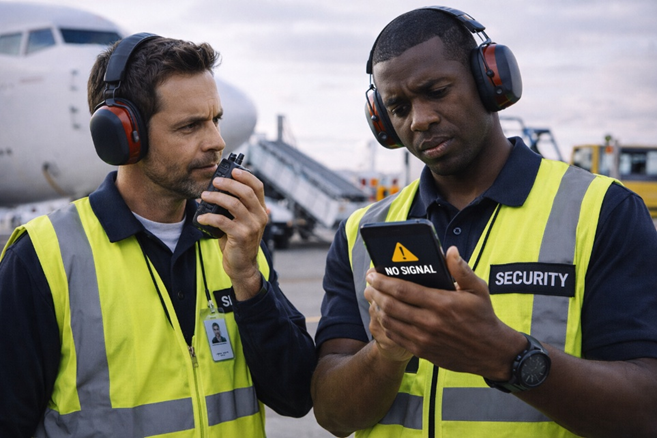
Table of Contents
Why Businesses Are Re-Evaluating Communication Tools
As businesses grow and operations become faster paced, communication becomes both more important and more challenging. Larger teams can make communication less efficient, increasing the risk of delays or missed messages. Many roles also involve safety-critical tasks that require constant coordination, such as emergency services, construction, transportation, and logistics. In these environments, clear and consistent communication is essential to avoid errors and downtime. Mobile phones can become unreliable due to network outages, poor signal, or congestion, all of which can disrupt communication at critical moments.
In operational environments, communication failures are a known risk, which is why industries such as construction, security, and emergency services continue to rely on dedicated radio systems.
Speed of Communication and Team Coordination
With two-way radios, users can communicate instantly using push-to-talk (PTT). Information can also be shared with an entire group at the same time, provided they are using compatible radios. This is especially crucial in urgent situations, where time cannot be lost contacting individuals one by one. Unlike mobile phones, there is no need to wait for a call to be answered — communication is immediate.
Reliability and Network Dependence
Cellular coverage is not always reliable and, in some areas, may be non-existent. This is especially common in remote locations, large buildings, underground areas, or busy environments where networks can become congested. When communication relies solely on mobile phones, these coverage issues can cause delays or missed messages, which can impact coordination and safety.
Battery Life and Power Management
Battery life is another important factor to consider in day-to-day operations. Mobile phones are often used for multiple tasks throughout a shift, which can quickly drain the battery. In contrast, two-way radios are designed for long working hours and typically last an entire shift without needing to be recharged. A loss of power can interrupt communication and create unnecessary disruption, particularly in environments where reliable communication is essential.
Durability in Demanding Work Environments
Durability also plays a key role in many working environments. Mobile phones are primarily designed for everyday consumer use and can be easily damaged when exposed to dust, water, drops, or loud, busy surroundings. Two-way radios, on the other hand, are built specifically for demanding conditions and are designed to withstand regular use in challenging environments. This makes them a more reliable option for teams working outdoors or in physically demanding roles.
Cost and Long-Term Practicality for Businesses
Cost and long-term practicality are also important considerations for businesses. While mobile phones often appear convenient, they typically involve ongoing monthly costs, data plans, and regular device upgrades. Two-way radios, by comparison, are usually a one-time investment with minimal ongoing costs and a longer device lifespan. For organisations with larger teams, this can make radios a more cost-effective and practical communication solution over time.
The Future of Two-Way Radios in a Smartphone World
Despite the continued growth of smartphones, two-way radios are far from becoming obsolete. Instead, they are evolving to meet modern communication needs, with improvements in digital technology, reliability, and integration. In many industries, the need for instant, dependable communication will always remain, particularly in environments where safety and coordination are critical. As a result, two-way radios continue to play an important role alongside smartphones, rather than being replaced by them.
Real-World Examples of Mobile Network Failure
During major emergencies, mobile phone networks can become overloaded or effectively inaccessible. In the 7 July 2005 London bombings, many people noticed that “their phones went dead,” with mobile coverage in parts of central London becoming almost unavailable due to network congestion and prioritisation for emergency services. This highlighted the limitations of relying solely on cellular networks during crises and the need for resilient communication systems that can operate independently of public networks, such as two-way radios.
After 7/7 exposed how mobile networks can fail under pressure, Push-to-Talk over Cellular (PoC) has emerged as a modern option that combines instant radio-style communication with wide-area cellular coverage. Used alongside traditional two-way radios, PoC helps businesses stay connected across larger, mobile teams while maintaining fast, push-to-talk coordination.
Outside of major emergencies, similar issues can occur during large public events or busy periods. At concerts, festivals, sports games, and other crowded gatherings, the sheer number of people using mobile phones in the same area can overload cellular networks and lead to slower data speeds, dropped calls, or unreliable service. This happens because mobile networks have limited capacity — when many devices try to connect at once, network performance degrades and users may experience congestion or failed connections. In these situations, event organisers and teams often rely on two-way radios because they operate independently of public cellular systems and provide consistent, reliable communication across staff and security teams.
For work environments where reliability matters most, two-way radios from Maximon Solutions are a proven communication solution businesses can count on.